How this dish came to life
Cultural significance
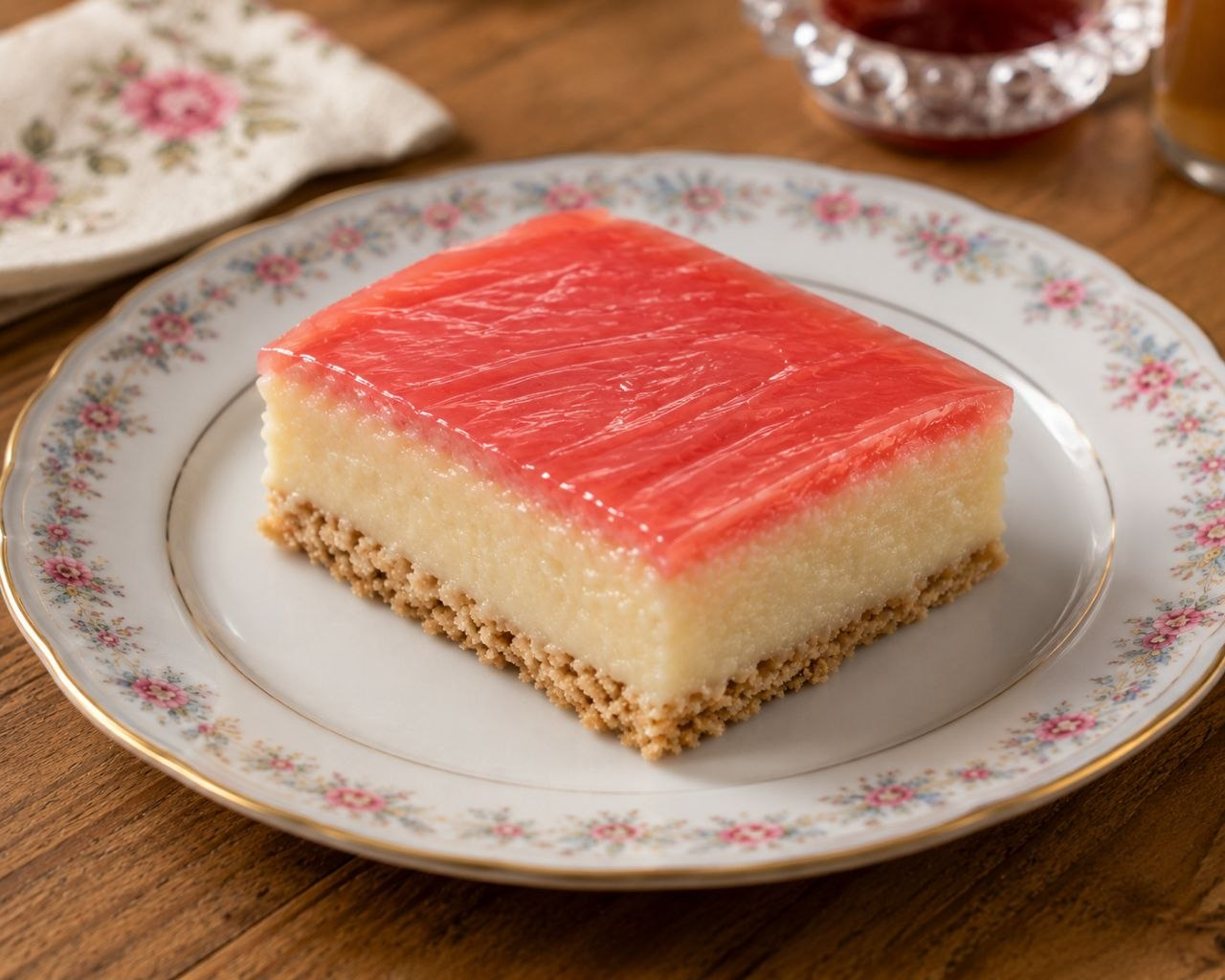
Biskotoglyko (μπισκοτογλυκο) is a post-war Greek home dessert that emerged in the mid-twentieth century with the arrival of industrially-produced petit beurre biscuits and powdered jelly on Greek supermarket shelves. Unlike most of the Greek dessert canon, it has no Byzantine, Ottoman, or Asia Minor lineage — it is a wholly modern Greek invention, born in the home kitchens of the 1950s, 60s, and 70s, and shaped by the rise of the urban Greek middle class. The three-layer construction (milk-soaked biscuit base, krema patissier middle, gelatin top) is borrowed from French patisserie tradition but reinterpreted with petit beurre — the iconic French Lu biscuit that became a Greek pantry staple — and Papadopoulos brand jelly powders, which dominated Greek kitchens from the 1970s onward. Today biskotoglyko is one of the most-prepared Greek home desserts, and a cherished symbol of the domestic Sunday-lunch culture of post-war Greece.
step by step
Instructions
- 1
Build the biscuit base first. Pour the cold milk for dipping into a wide shallow bowl. One by one, dip each petit beurre biscuit into the milk for just 2–3 seconds — just enough to soften it slightly, never long enough to make it crumbly. Lay each biscuit flat in a 25 × 30 cm rectangular glass dish, fitting them tightly together. Cover the entire base in a single layer.
- 2
Lay a second layer of milk-dipped biscuits on top of the first, in the same way. This double-biscuit base is what gives biskotoglyko its characteristic spongy bottom layer that holds the cream beautifully.
- 3
Now the cream. In a heavy-bottomed saucepan, combine 600 g of the milk (reserve the last 100 g separately), the heavy cream, and the vanilla. Place over medium heat and bring slowly to just below a boil — bubbles ring the edge of the pan but don't break the surface. Take off the heat.
- 4
In a wide bowl, whisk together the sugar and the cornstarch. Pour the reserved 100 g of cold milk into the cornstarch and sugar, whisking until completely smooth — no lumps. This is essential: cornstarch lumps never disappear.
- 5
Pour the hot milk-and-cream mixture slowly into the cornstarch slurry, whisking constantly. Once everything is combined and smooth, return the whole mixture to the same saucepan.
- 6
Cook the cream over medium heat, whisking continuously, for about 5–7 minutes. It will gradually thicken — first like single cream, then like double cream, then like a glossy custard that coats the back of a wooden spoon. Don't stop whisking. Lumps form in seconds if you do.
- 7
Take the pan off the heat the moment it reaches a pudding consistency. Add the butter and stir until it has melted into the cream — this gives the krema its signature glossy, silky finish.
- 8
Pour the warm cream over the biscuit base, smoothing it gently with a spatula so it reaches every corner. Don't press down on the biscuits.
- 9
Cover the dish with cling film pressed directly onto the surface of the cream (this prevents a skin from forming). Refrigerate for at least 2 hours, until completely cold and firmly set.
- 10
Once the cream is fully set, prepare the jelly. Follow the packet instructions: usually 250 ml of boiling water poured over the jelly powder and stirred until completely dissolved, followed by 250 ml of cold water added at the end to cool it down. Let the jelly cool to room temperature — never pour hot jelly over cold cream, or the cream surface will melt and merge into the jelly.
- 11
When the jelly is cool but still liquid, pour it gently and evenly over the cold cream layer. Pour close to the surface (almost touching it with the spout), in a slow, wide circle, so the cream doesn't dent under the weight of the liquid.
- 12
Optionally, set a few fresh berries or thin fruit slices into the jelly before it begins to firm — they will hang suspended like jewels.
- 13
Return to the fridge for at least 2 more hours, until the jelly has fully set to a glassy, snappy lid.
- 14
Cut into generous squares with a sharp knife dipped in hot water and wiped clean between cuts. Lift each square out gently with a wide spatula and serve on small floral plates (Yiayia style), with a small spoon. The first bite should crack through the jelly, sink into the cream, and finish on the biscuit. Three textures. One generation's whole childhood.
tips from the village —
Wisdom from grandmothers
- 01Dip the biscuits for just 2–3 seconds. Over-dipping turns them mushy and the bottom layer collapses. Quick dip is the secret.
- 02Whisk the cornstarch into cold milk only. Hot milk seizes the starch into lumps that no whisking will smooth out.
- 03Whisk the cream continuously while it thickens. This is the only difficult moment in the recipe — five minutes of constant whisking means a silky pudding instead of a curdled one.
- 04Cool the jelly before pouring. Pouring hot jelly over cold cream melts the cream's surface and the layers blur — let the jelly cool to room temperature first.
- 05Cling film directly on the cream's surface stops a skin from forming. This is the krema patissier rule and it matters.
- 06Make it the day before. Biskotoglyko firms beautifully overnight and the flavours marry — like every great home dessert, it improves with patience.
- 07Watermelon, cherry, and strawberry jellies are the most photogenic. Lemon is more elegant. The flavour is entirely a matter of family preference.
- 08Cut with a knife dipped in hot water for clean lines through all three layers.
Related recipes
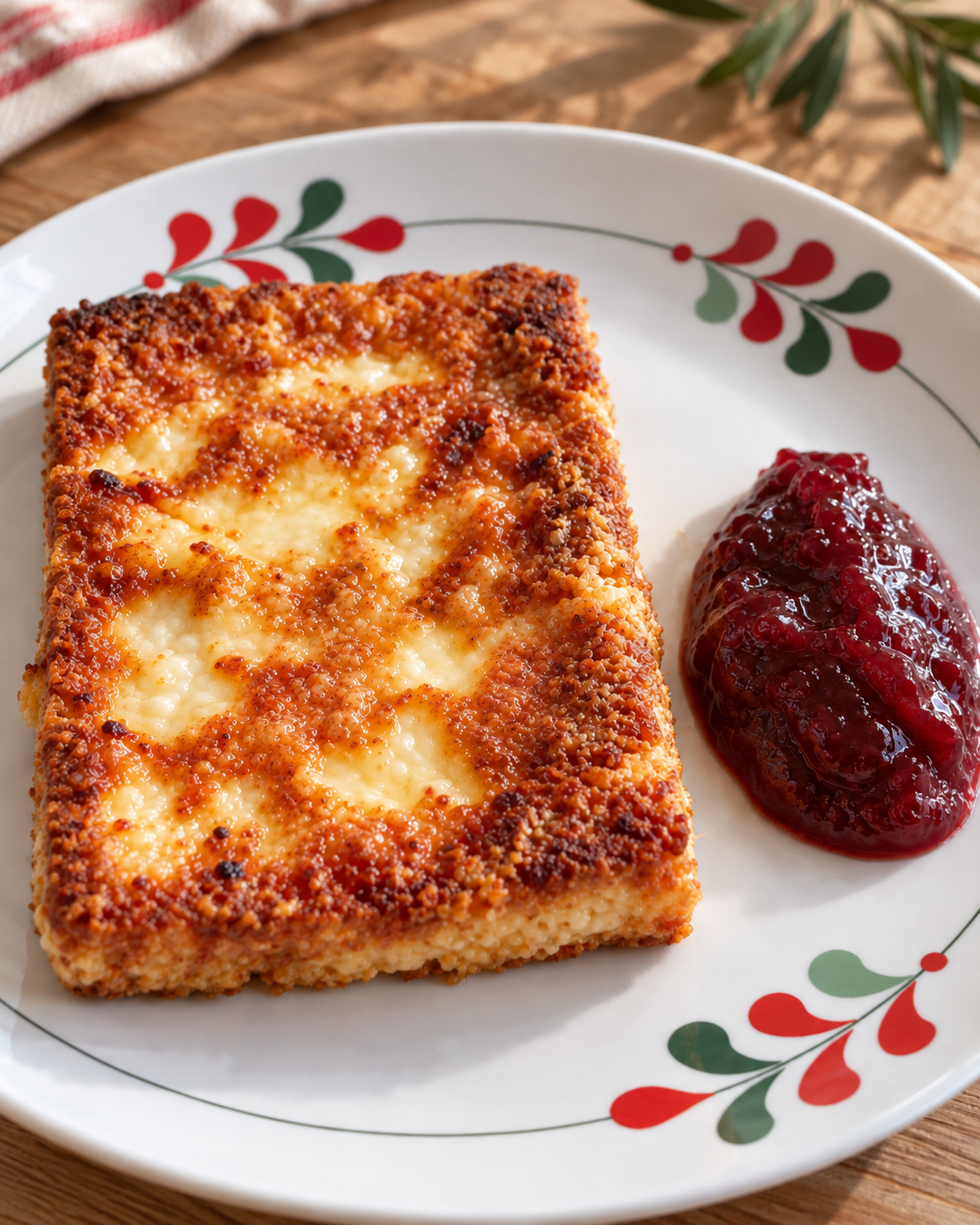
Saganaki with Grape Jam
Golden fried cheese, crisp outside and molten within, served with a slow-cooked grape jam brightened with lime — the taverna classic named after its little pan.
Read the story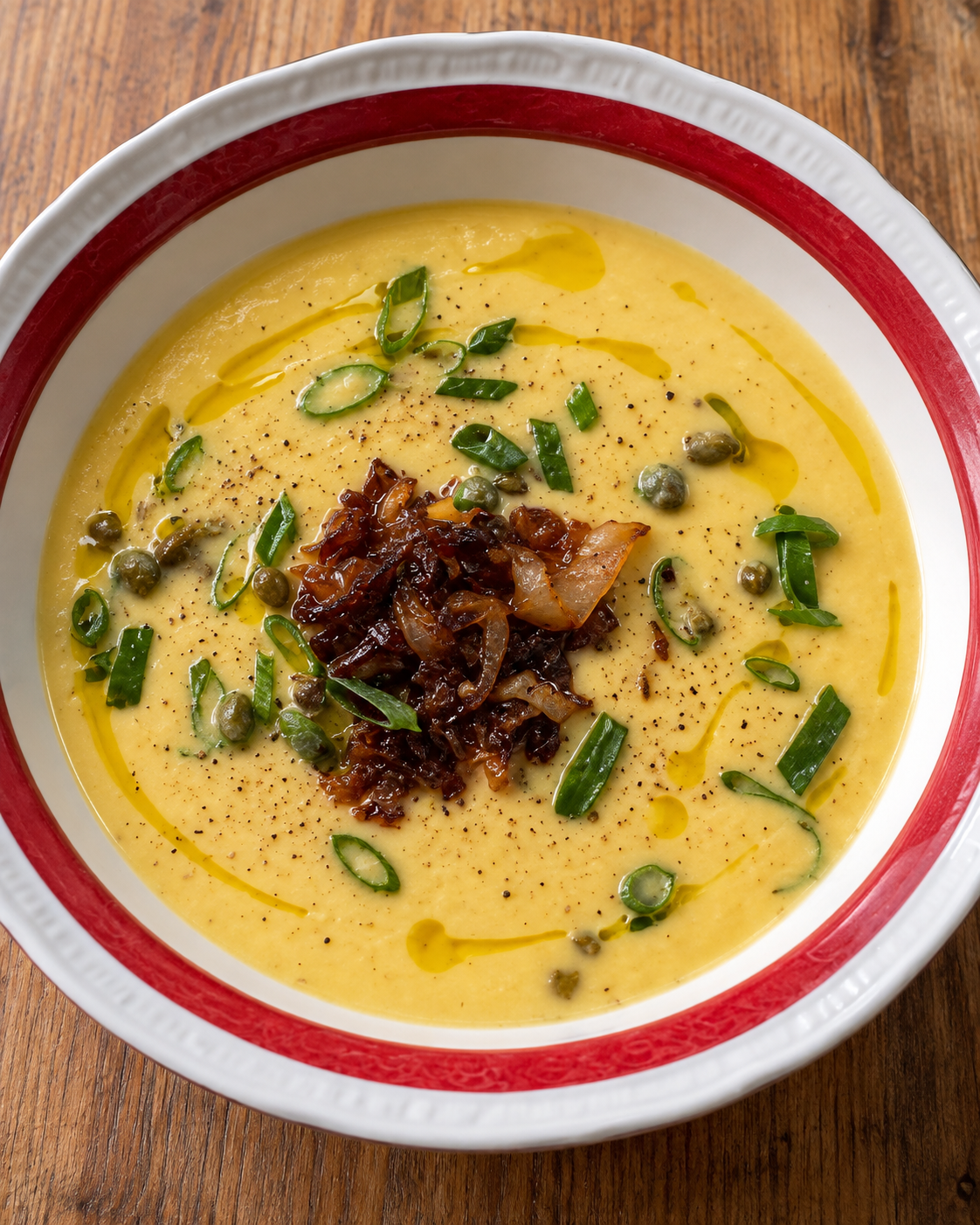
Fava
Silky yellow split-pea purée crowned with caramelized onions and capers — a dish that survived the volcano that buried ancient Santorini.
Read the story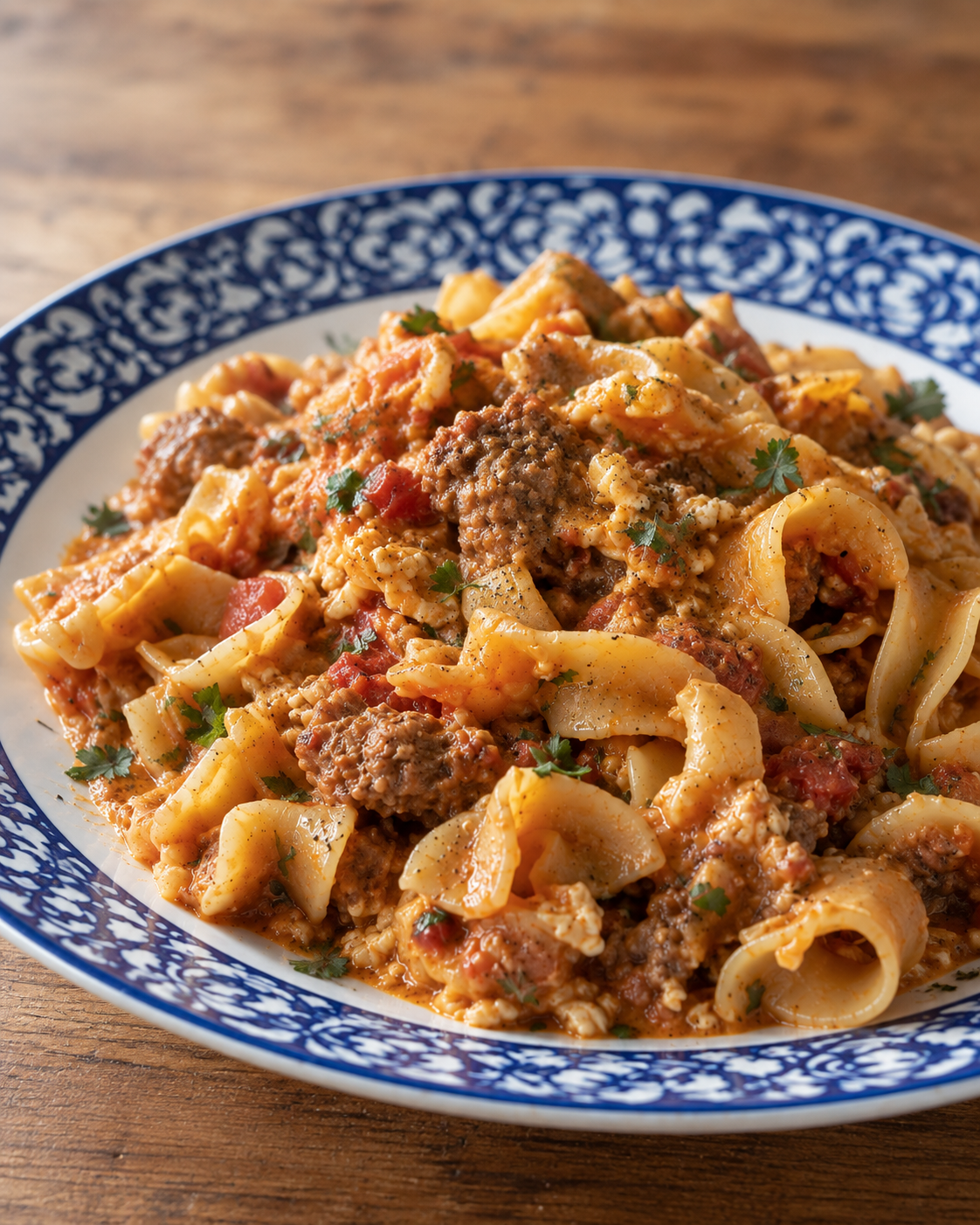
Hilopites with Sausages & Eggs
Greece's village egg pasta simmered with sausages, peppers and tomato, finished with eggs stirred through for creaminess — topped with feta and wild oregano.
Read the story